1000 Word News Feature
Iconic artist shares stage with Coventry BA Art students
Pandemonium is a pop-up exhibition at the Mead Gallery by second-year fine art students at Coventry University, which was shown alongside Takuro Kuwata.
By Third year Coventry University student Harrison Pearce
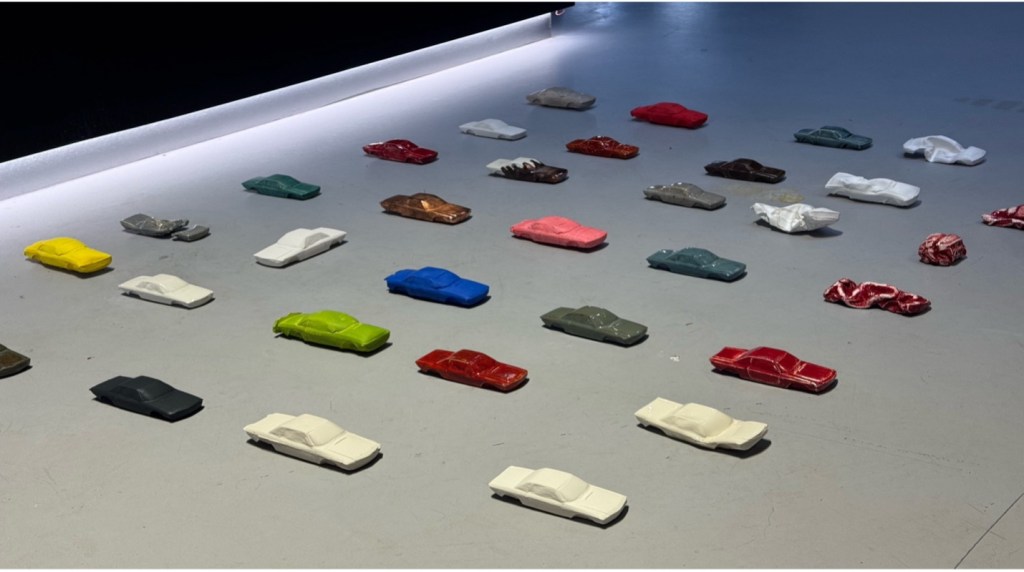
John Wilson’s Artwork: kiln forged, yard bound
Concept and Curatorial Approach
For one night only, the walls of The Mead Gallery became a meeting point between emerging and established artistic voices. BA Art students from Coventry University saw their work curated and presented alongside that of a leading contemporary artist.
A key part of the show was that students had their work sit next to leading artist Takuro Kuwata’s Tea Bowl Punk. The student artists pushed their own ideas and materials further than ever before. They used Kuwata’s work as a starting point and inspiration to create a wide range of responses, both visually and emotionally.
In the shadow of Kuwata’s work, this sense of excess becomes particularly resonant. Kuwata’s ceramics are characterised by explosive textures, vivid glazes, and distorted forms that challenge traditional Japanese pottery while remaining rooted in it. His practice fuses historical technique with a punk-inflected aesthetic, drawing on the visual language of Pop Art and the irreverence of contemporary culture. The presence of such work inevitably frames the student exhibition: colour becomes more saturated, material more assertive, gesture more exaggerated.
Material Experimentation with Takuro Kuwata’s Work
Several works in Pandemonium appear to respond directly to this material intensity. Sculptural pieces experiment with surface in ways that echo Kuwata’s interest in glaze and texture. Though often translated into different media with plaster, resin, or found materials. These works suggest a generation of artists attuned to tactility and process, foregrounding the act of making as much as the final object. At their best, they capture a similar sense of precariousness: forms that appear on the verge of collapse, surfaces that seem unstable or in flux.
One of the BA art students, John Wilson, spoke about him learning a lot from the Mead Gallery. “I think it was a great experience to show your work in a professional environment.”
“This was my first exhibition outside of University, so I was nervous at first, but it was amazing to work alongside curators and my fellow students to make it successful.”
John Wilson went on to say that “I learned a load of skills like installation and also working with all the curators really pushed me to my limit because I came in with one idea, but they spoke with me and changed it dramatically.”
The Mead Gallery as a Contemporary Art Space
The Mead is situated within the cultural landscape of Warwick and has held a long reputation as one of the most respected galleries outside of London. It’s known for its ambitious programming and carefully considered exhibitions. This offers artists a context that is both rigorous and generous for students still completing their undergraduate studies. Exhibiting here is not simply an opportunity; it is a validation of seriousness and intent.
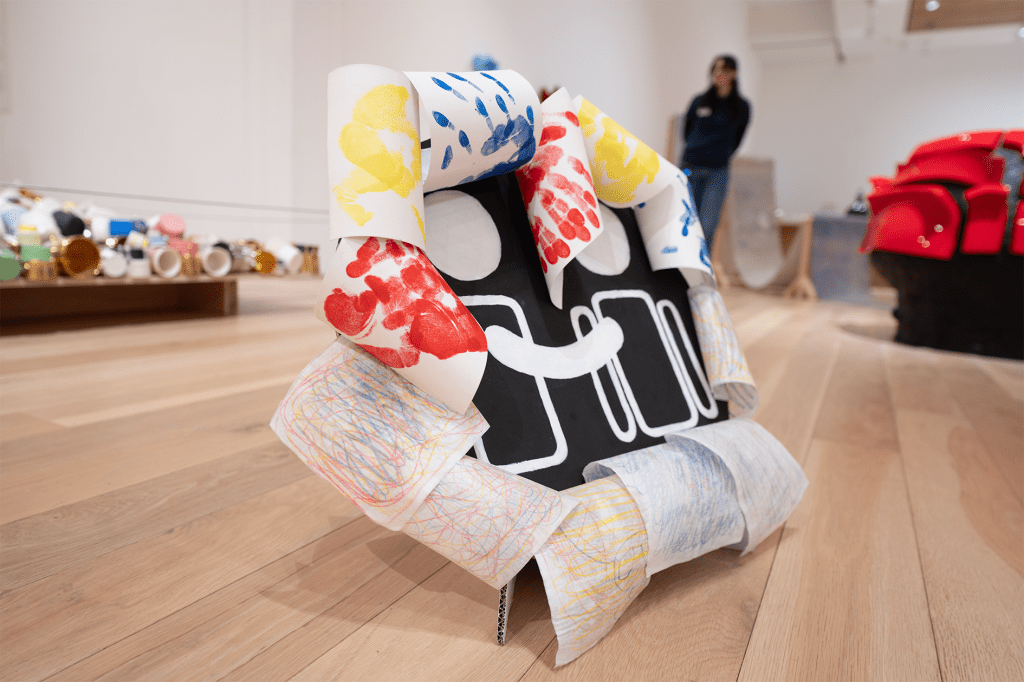
One of the most compelling aspects of Pandemonium is its engagement with installation as a mode of practice. Rather than presenting discrete objects, several artists construct environments that invite the viewer to move through, around, or even within the work. This spatial awareness resonates with the gallery’s architecture and creates moments of immersion that contrast with Kuwata’s object-based sculptures. In these instances, the exhibition expands beyond material experimentation into questions of experience and perception.
Sound also plays a notable role. The audio elements are either ambient noise, recorded speech, or abstract compositions. They introduce a temporal dimension that disrupts the visual dominance of both exhibitions. These works contribute to the sense of “pandemonium” not as chaos, but as a layering of sensory inputs. The gallery becomes a site of overlapping frequencies, where visual and auditory elements compete and coalesce.
Audience Engagement and Interpretation
Craig Ashley, the deputy head of creative arts and industries, stated that “Audiences will look at our work as professional artists working in the sector today, and that’s so rewarding to see the fact that our students are learning the process.”
Craig went on to say, “The confidence the students can receive from this type of experience, which is applied, active, and in the real world, is the confidence driver that can lay the pathways to the career that they want to go into.”
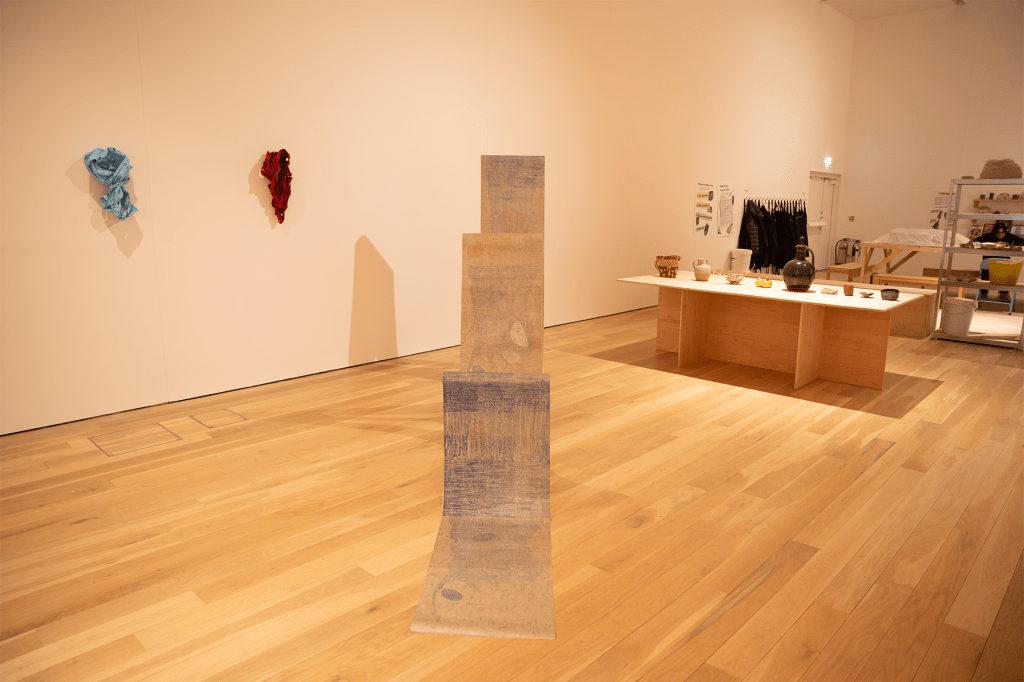
Pat Farrell’s Artwork: Clash
What made this exhibition particularly compelling was its curatorial approach, because rather than separating student work into a peripheral or subsidiary display, the curators interwove it directly with that of the established artist. Paintings conversed across walls; sculptural forms echoed and disrupted one another; conceptual pieces shared both physical and intellectual space. The result was not a hierarchy, but a dialogue.
Collaborative and Educational Context
Nevertheless, the exhibition succeeds in asserting its own presence. Rather than being subsumed by Kuwata’s work, it creates a parallel narrative. One that reflects the uncertainties and possibilities of emerging practice. If Kuwata’s exhibition represents a mature, fully realised artistic vision, Pandemonium captures the process of becoming: a snapshot of artists during development.
For the BA Art students at Coventry University, the event marked a significant milestone. To have their practice contextualized within one of the region’s foremost galleries speaks to both the strength of their programme and the ambition of the curatorial team. It was a reminder that contemporary art thrives on exchanges between generations, disciplines, and stages of career.
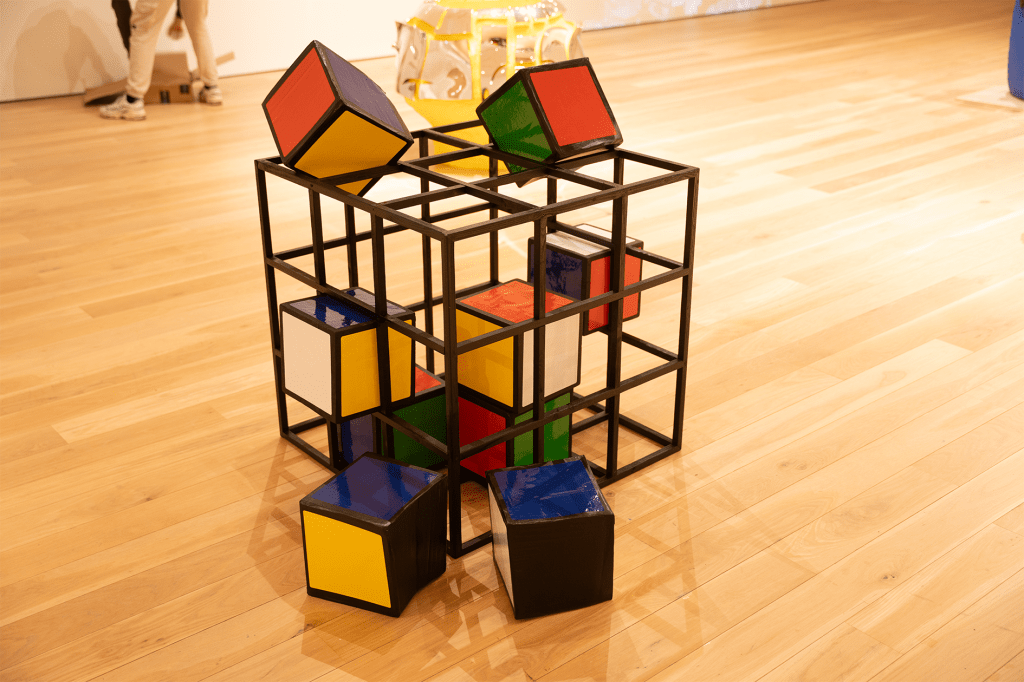
Conclusion: Impact and Future Directions
For one evening in Warwick, the boundaries between student and established artist dissolved. In their place stood a shared space of inquiry, experimentation, and dialogue. This is exactly the kind of encounter that keeps contemporary art urgent and alive.
In this sense, Pandemonium does exactly what a student exhibition should do: it opens questions rather than closing them down. It invites viewers to engage with art not as a fixed product, but as an ongoing process which is messy, dynamic, and full of potential.
Ultimately, Pandemonium is less about resolution than about potential. Its strengths lie not in polish or cohesion, but in its openness, in its willingness to experiment, to fail, and to explore. In dialogue with Kuwata’s work, it highlights the multiplicity of contemporary art practices and the different trajectories they can take.
Profile Interview
Why Birmingham food reviewer, likes to stay hidden in the shadows in a flashy modern landscape?
Local food reviewer in Birmingham, Jay, also known as Btown on Instagram, tends to avoid chains like the plague.
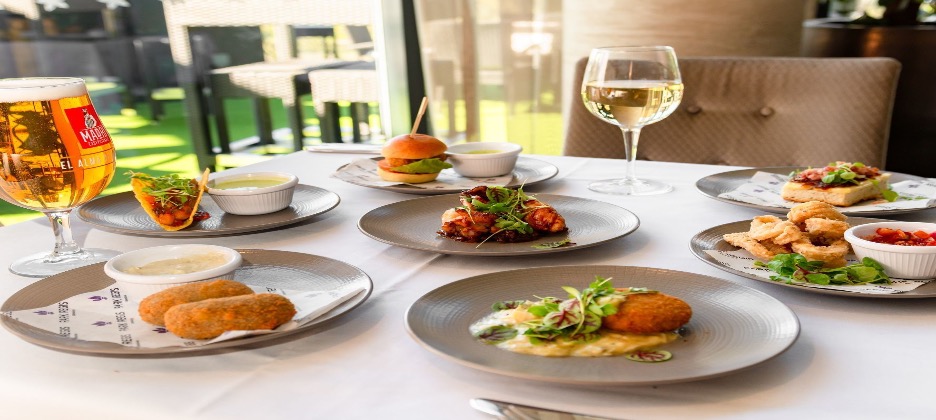
In an era dominated by viral food trends and big-name chains, independent restaurants often struggle to compete for visibility. Social media has levelled the playing field, but only if used thoughtfully. Food reviewers today are more than critics; they are storytellers, community builders, and economic influencers. When used strategically, social platforms can meaningfully boost independent restaurants without compromising credibility.
Escaping the Influencer Economy
Local food reviewer in Birmingham, Jay, also known as Btown on Instagram, tends to avoid chains like the plague (where possible), so his main mission has always been to spread awareness of independent places. He allows pubs, as they serve the community in a way that chain restaurants don’t. More of a social hub, which he has a lot of time for.
“I tend to try and explore too, so I’m just as at home in a trendy coffee place as I am in a grilled fish restaurant on the Stratford Rd, or a chai place in Lozells.”
“So long as I enjoy it, I’m happy telling people about it. It could be a Michelin restaurant, a local greasy spoon, or an authentic desi breakfast place. I blog places I enjoy, and people can decide for themselves with the words and pictures I present.”
The Power of Anonymity in a City That Loves the Spotlight
Independent restaurants in Birmingham can compete with large chains by offering unique, authentic, and high-quality experiences that prioritize local sourcing and community engagement, despite facing intense cost pressures. While chains offer consistency and marketing power, independent venues thrive on agility, personalized service, and distinct, often superior, culinary offerings.
| Top 5 reasons for choosing an establisment | % of Diners |
| I’ve been there before | 33.4% |
| It’s good valve for money | 24.1% |
| Quality of ingredients | 20.4% |
| Loca and Independent | 16.2% |
| Proximity | 15.8% |
Table from the UK Food Council
Letting the Food Speak Louder Than the Face
Independent restaurants often attract diners wanting to support local businesses, often leveraging social media for direct marketing. They will often invite bloggers from their local area in order to access some free promotion. Independent restaurants rarely have massive marketing budgets. What they do have is a story.
Instead of focusing solely on flavor profiles and plating, reviewers could highlight the owner’s journey. cultural roots behind the cuisine, family traditions, challenges overcome, and community ties. A compelling narrative transforms a restaurant from “a place to eat” into “a dream someone built.” Audiences are far more likely to support a business when they feel emotionally connected to it.
Unlike chain menus, independent restaurants in areas like Stirchley or the Jewellery Quarter often provide unique, high-quality, and authentic experiences. Local food reviewer in Birmingham, Jay, also known as Btown on Instagram, shares why Birmingham influencers often highlight big brands rather than smaller places.
“Birmingham has a really good food community where people are well-connected and help each other out.”
“You get the Instagram bloggers, who like to go out together to the popular places, which are highly decorated, flashy new place that always brings attention.”
Food reviewers blog about popular food chains for strategic, practical, and audience-driven reasons. Well-known brands such as McDonald’s, Starbucks, and KFC already have recognition, which means every time they create a new menu, their audience will instantly search to see if it is worth it or look for the best item, for example.
Did you know:
Jay never accepts invitations to openings because his supporters don’t want to see him filming fire breathers or magicians on an opening night. Instead, he waits a month for the excitement to die down and goes as a random punter. Jay believes people get way more out of what is a very real experience.
Dining Like a Regular, Not a VIP
Reviewing something familiar lowers the barrier for engagement. The audience doesn’t need an introduction; they want an opinion. This is what makes it so hard for independent businesses to compete with because knowing that there is a market of people who want something fast and familiar, will just choose a well-known brand without thinking.
However, Birmingham food reviewer Jay likes to invest his time into trying local cuisines that not everyone has tried.
“I like going to Laeles, or Small Heath, Stratford Road, and Coventry Road because they are not massively pushed.”
“I just blog where I go, I don’t think about going to the fancy new restaurant to get the likes, I want to spread the word about cuisines that don’t get the coverage.”
The Psychological Freedom of Being Unseen
The Birmingham food scene is like a playground; there are so many options that don’t get the respect they deserve because they aren’t pushed on the search engine or algorithm. That’s why it is so important for independent restaurants to build that strong connection with their customers through engagement and make it so that they want to come back.
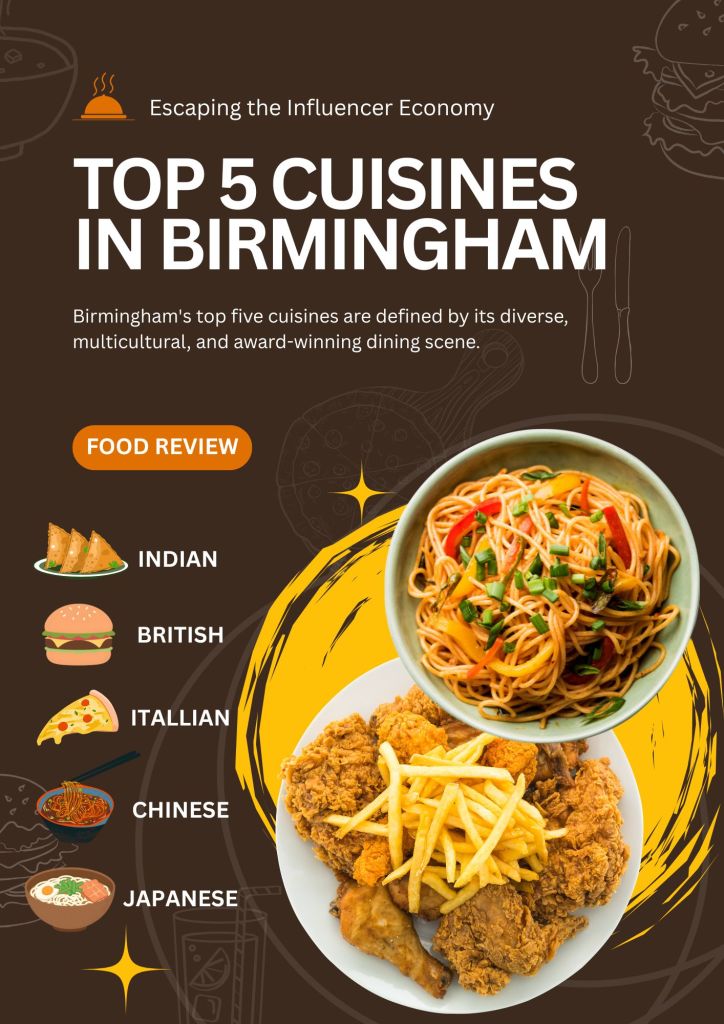
Food reviewer Jay or better known as Btwon, lastly told us about the contributions his reviews have on local businesses.
“Its the only reason I do it, because there have been times where a few places have told me they have received more customers as a result of my reviews.”
“I know that my reviews can be good for the places I go to. People aren’t quick to thank (and I don’t do it for that, but it’s always nice), but sometimes I get told directly that sales or bookings were slow until i visited and then posted about the place.”
“I know one place that received a big order, amongst other interests, just after I raised awareness about them. That always feels pretty good.” The heart of the city’s culinary identity lies in its independent restaurants, such as family-run curry houses, neighbourhood cafés, Caribbean kitchens, artisan bakeries, and chef-led bistros. There is so much variety of restaurants in Birmingham that don’t get the social media hype but are still adored by many. Maybe this is your chance to switch off your phone and dine at your local cuisine down the road.
 My Portfolio